Back to Blog
Children become better readers when they learn both how print works and how language carries meaning. Rich conversation helps build words and knowledge. It also helps children understand sentences, reason through ideas, and make sense of what the words on a page are saying.
Imagine two children reading the sentence, “The exhausted hikers finally reached the shelter.” Both can sound out the words. One child knows that exhausted means extremely tired, understands why hikers need shelter, and can picture what finally tells us about their long effort. The other child reads the sentence accurately but cannot explain it. The difference is not in decoding. It is in comprehension and knowledge.
Reading with understanding requires both accurate word reading and an understanding of spoken language. Strong reading instruction therefore teaches letters, sounds, spelling patterns, and word reading directly. It also builds vocabulary, knowledge, and comprehension. [1-3]
Conversation builds the language that reading depends on
Before children can read a sentence, they begin learning how sentences work by listening and talking. For example, conversation gives them practice following ideas and understanding who or what a pronoun refers to. It also helps them notice cause and effect and connect one sentence to the next. These language skills later help children build a clear picture of what a text means.
A large review of long-term studies found that preschool language skills were linked with later reading comprehension. These early skills included vocabulary and the ability to understand and tell stories. Knowledge of letters and speech sounds also mattered, mainly because it supported later word reading. The two paths work together: children need to read the words and understand the language those words create. [3]
This is an important guardrail. Talking with children does not replace explicit reading and spelling instruction. It strengthens a different part of reading. A child can have strong ideas but weak decoding, or accurate decoding but weak understanding. Good teaching checks and supports both.
Words grow through meaningful use
Knowing a word is more than repeating a short definition. A child who truly knows the word fragile can recognize it when someone says it and explain it in simple language. They can also connect it with words such as breakable and delicate, use it in a sentence, and understand what it adds to a story. That depth grows through repeated encounters in meaningful settings.
Long-term research following children from first through fourth grade found that stronger vocabulary was linked with faster growth in reading comprehension later on. This kind of study cannot prove that one word lesson causes broad reading growth, but it shows why vocabulary deserves sustained attention. [4]
Conversation helps turn a new word into usable knowledge. An adult can name and explain the word, then give an example. The adult can ask the child to connect it with an experience and use it. The back-and-forth reveals misunderstandings that silent memorization can mask.
Rich talk also builds knowledge
Every text expects the reader to bring some knowledge. A book about migration makes more sense if a child knows that animals may travel when seasons change or food becomes scarce. A story about voting is easier to follow if the child understands choice, rules, and counting decisions.
Conversation helps adults connect new information with what a child already knows. It also lets children compare ideas, sort examples, and explain relationships. A controlled study tested lessons that joined first-grade literacy with connected science content. The lessons improved science knowledge and produced a small gain on a broader reading-comprehension measure. [9]
This matters for vocabulary too. Words are easier to understand when they belong to one clear topic instead of a random list. Children can discuss habitat, predator, prey, shelter, and survive together. This creates a web of meaning that can support further learning.
What makes a conversation rich?
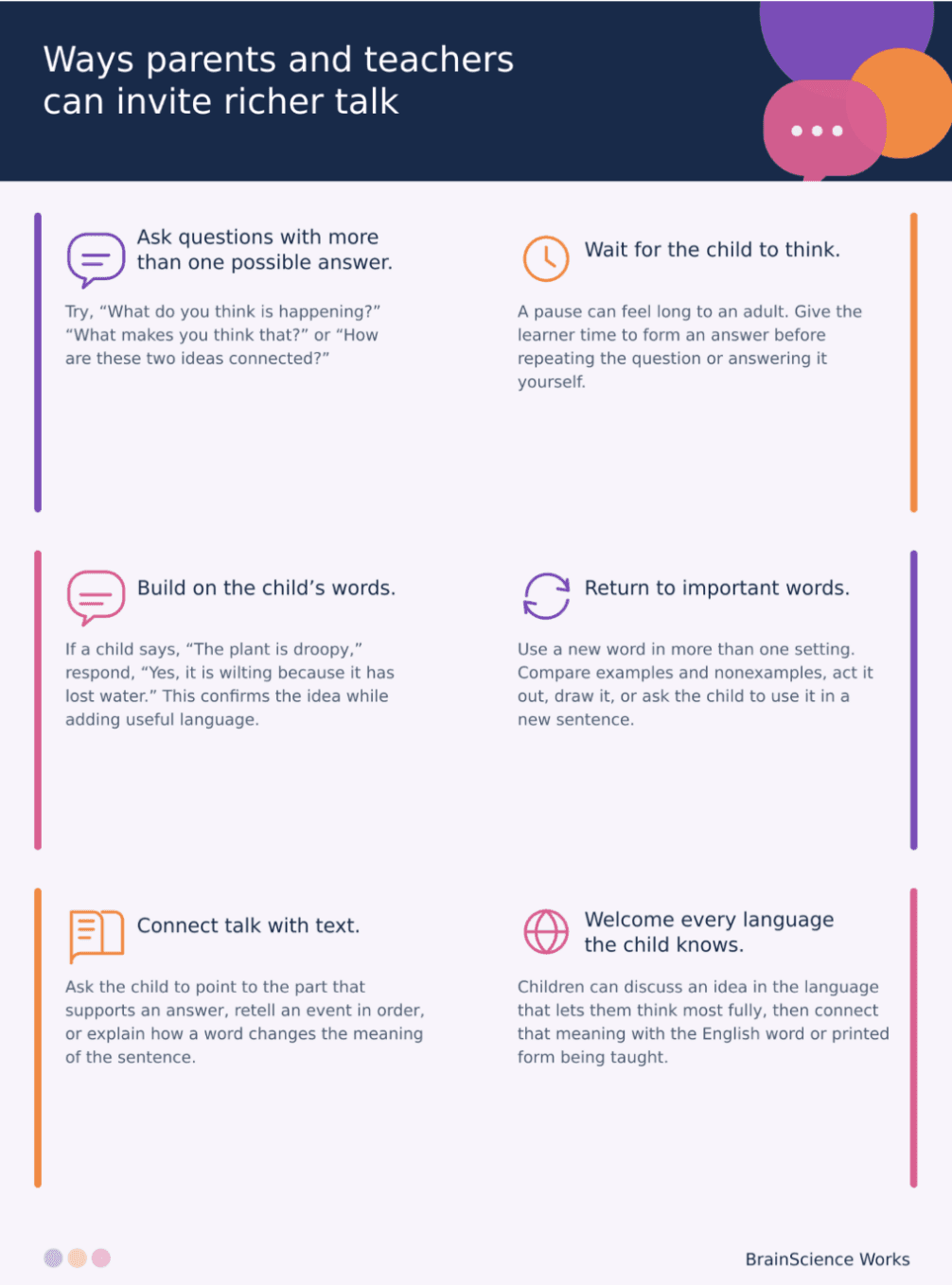
A rich conversation is not simply an adult saying many words. It is a back-and-forth exchange. The child has something real to think about and enough time and support to respond. The adult listens and builds on the response. The adult also adds useful language and asks a next question that moves the idea forward.
A long-term classroom study found that features of preschool teacher talk predicted later language and reading outcomes. These features included more advanced vocabulary and thoughtful talk about books. [5]
A stronger test came from Story Talk, a planned preschool book-reading program. Teachers learned to teach target words and ask open questions. They also extended children's answers and returned to words in later activities. Children in the program made greater vocabulary gains than children in comparison classrooms. [7]
Discussion can deepen comprehension
After reading, a weak question may only ask for a fact: “What color was the boat?” A richer question asks the child to connect evidence and meaning: “Why did the character choose the boat even though the water was rough?” The second question requires the reader to explain a reason, return to the text, and consider more than one detail.
Federal guidance recommends focused discussion about the meaning of text. It includes follow-up questions that ask students to think deeply. The guide rated the direct evidence for this advice as limited. A separate meta-analysis found that several classroom discussion methods improved student talk and text comprehension. Results varied by method, measure, and student group. Most studies involved students in grades four through six. [1, 8]
Language-focused programs from kindergarten through fifth grade also show a useful pattern. They tend to improve the vocabulary and listening skills they teach. Gains on broad reading measures are smaller or less consistent. Rich conversation is valuable, but it works best as part of a complete reading program rather than as a stand-alone solution. [10]
How BrainScience Works connects words with meaning
BrainScience Works treats meaning and comprehension as part of word learning. They are not extra steps that come after spelling. Students say a word and explore what it means. They build the printed word in clay, model its meaning, look closely at the finished word, and write it. The lesson keeps the spelling visible while asking the learner to connect that spelling with a real idea.
This routine brings together several parts supported by research. These include direct attention to print, clear word teaching, repeated meaningful use, links among related ideas, and questions that require an explanation. Building the word supports close attention to its spelling. Modeling and discussing the meaning can deepen vocabulary and comprehension by making the learner explain what the word does in a sentence or situation. [1, 4, 6, 7]
A final word
A reader must do more than pronounce the words on a page. Strong readers must connect them and fill in what the author leaves unstated. The goal is to build a meaningful whole. Rich conversations give children daily practice doing that work with support. Conversations should work with direct print teaching, reading, spelling, and knowledge building. When these parts work together, children are better prepared not only to read the words, but to understand and use them.
Sources
1. Shanahan, T., Callison, K., Carriere, C., Duke, N. K., Pearson, P. D., Schatschneider, C., & Torgesen, J. (2010). Improving Reading Comprehension in Kindergarten Through 3rd Grade: A Practice Guide. Institute of Education Sciences, U.S. Department of Education. View source
2. Foorman, B., Beyler, N., Borradaile, K., Coyne, M., Denton, C. A., Dimino, J., and colleagues. (2016; revised 2019). Foundational Skills to Support Reading for Understanding in Kindergarten Through 3rd Grade. Institute of Education Sciences, U.S. Department of Education. View source
3. Hjetland, H. N., Brinchmann, E. I., Scherer, R., Hulme, C., & Melby-Lervag, M. (2020). Preschool pathways to reading comprehension: A systematic meta-analytic review. Educational Research Review, 30, 100323. View source
4. Quinn, J. M., Wagner, R. K., Petscher, Y., & Lopez, D. (2015). Developmental relations between vocabulary knowledge and reading comprehension: A latent change score modeling study. Child Development, 86(1), 159-175. View source
5. Dickinson, D. K., & Porche, M. V. (2011). Relation between language experiences in preschool classrooms and children's kindergarten and fourth-grade language and reading abilities. Child Development, 82(3), 870-886. View source
6. Marulis, L. M., & Neuman, S. B. (2010). The effects of vocabulary intervention on young children's word learning: A meta-analysis. Review of Educational Research, 80(3), 300-335. View source
7. Wasik, B. A., & Hindman, A. H. (2020). Increasing preschoolers' vocabulary development through a streamlined teacher professional development intervention. Early Childhood Research Quarterly, 50, 101-113. View source
8. Murphy, P. K., Wilkinson, I. A. G., Soter, A. O., Hennessey, M. N., & Alexander, J. F. (2009). Examining the effects of classroom discussion on students' comprehension of text: A meta-analysis. Journal of Educational Psychology, 101(3), 740-764. View source
9. Kim, J. S., Burkhauser, M. A., Mesite, L. M., Asher, C. A., Relyea, J. E., Fitzgerald, J., & Elmore, J. (2021). Improving reading comprehension, science domain knowledge, and reading engagement through a first-grade content literacy intervention. Journal of Educational Psychology, 113(1), 3-26. View source
10. Silverman, R. D., Johnson, E., Keane, K., & Khanna, S. (2020). Beyond decoding: A meta-analysis of the effects of language comprehension interventions on kindergarten through fifth-grade students' language and literacy outcomes. Reading Research Quarterly, 55(S1), S207-S233. View source
BrainScience Works Literacy
Build stronger readers, step by step.

About the Author
Taylor Hovish
Taylor comes to us with over a decade of experience in special education and school administration. She holds a graduate degree from Harvard University where she conducted research on children's understanding of various teaching techniques. She has presented at the American Educational Research Association, facilitated workshops at Learning and the Brain conferences, been published in 2e Magazine, and most recently, authored a children’s book in the “A Kid’s Book About…” series. She is passionate about community service and has extensive volunteer experience as a Professor at Mount Tamalpais College at San Quentin and as a Court Appointed Special Advocate for foster youth. Taylor is excited to bring her expertise and passion for strengths-based learning to BrainScience Works!