Back to Blog
Struggle is not always a sign that learning has failed. It can mean that a child is doing the work of learning: remembering, testing an idea, noticing an error, and trying a better approach. But struggle helps only when the goal is within reach and the child has enough teaching, time, feedback, and support to make progress.
Imagine a child trying to read a word that was practiced yesterday. The child pauses, says the first sound, looks through the whole word, and makes a close attempt. An adult may feel tempted to give the answer at once. Yet a few seconds to think, followed by a useful clue if needed, may let the child retrieve the word and experience real success.
Now imagine a different child staring at unfamiliar print with no clear strategy. The child becomes upset and starts guessing. Waiting longer will not turn this into useful effort. The child needs direct teaching or a smaller step. These scenes look similar from the outside, but only the first is productive struggle.
What is productive struggle?
Productive struggle is effort that moves learning forward. The learner has a clear goal, some knowledge or strategy to begin with, and a task that requires thought. The answer is not supplied too soon, but help is available before confusion becomes overwhelming. Feedback then helps the learner connect the attempt with a more accurate idea. [1, 2, 5-7]
It is not the same as leaving a child alone to discover everything. A major review compared lessons that began with problem solving with lessons that began with instruction. Trying first produced better understanding and transfer overall, especially when the later teaching used students' attempts. However, results changed with age and subject. For children in grades two through five, the average result favored instruction first. [1]
That finding gives adults a useful boundary. Children can benefit from effort and mistakes, but the right order matters. Young learners often need a clear model first. Productive struggle may then happen during guided practice, when the child recalls a letter sound, blends a word, corrects a spelling, or explains a meaning.
Easy performance is not always lasting learning
A task can feel smooth because the answer was just shown, not because the learner can produce it later. Research distinguishes performance during a lesson from learning that lasts after the lesson ends. Conditions that make practice look slower or less perfect can sometimes improve later memory. [3]
Trying to recall an answer is one example. In a controlled study with college students, repeated recall led to better long-term memory than repeated study, even though studying again looked easier in the moment. The learners were adults, so the exact results should not simply be assigned to young children. Still, the study supports a broad finding repeated across learning research: retrieving knowledge can strengthen it. [4]
For a beginning reader, that may mean briefly covering a practiced word and asking the child to build or write it again. A pause or an imperfect first attempt does not prove that the lesson failed. It gives the teacher information about what the child can bring back without copying and what still needs support.
Errors can become useful information
An error can show which part of a skill is missing. A child who reads stop as spot may know all four sounds but need help checking their order. A child who spells said as sed may be using sensible sound knowledge but still need to learn the word's unexpected spelling. A wrong answer is not the end of the lesson. It is evidence about the next teaching move.
A major review of error research found that making an error and then receiving corrective feedback can support learning. The correction is the essential part. Errors do not teach themselves, and repeated mistakes without clear correction may become more confusing. The review also found value in examining the thinking that led to the mistake. [2]
Useful feedback is specific and focused on the task. Instead of saying only, “Try again,” an adult might say, “You have the right sounds. Check which letter comes second.” Instead of “That is wrong,” the adult might ask, “What does your model show? Does it match the word?” Reviews of feedback research support timely, supportive information that helps a learner change the next attempt. [5]
The challenge must fit the learner
The goal is not maximum difficulty. A national research synthesis concluded that learners tend to persist when a challenge is manageable: neither too easy nor too frustrating. Motivation is also supported when children see progress, feel some control, and learn in a safe environment. [7]
The same task can be productive for one child and overwhelming for another. A familiar word with one tricky part may invite useful thought. A page filled with unknown patterns may leave the child with no path forward. Working at a learner's pace does not mean removing the goal. It means adjusting the size of the step, the amount of practice, and the timing of support.
This is especially important in early literacy. Federal guidance recommends direct teaching of speech sounds, letters, decoding, word parts, writing, and word recognition, followed by guided practice and daily reading. Productive effort should happen inside strong instruction, not in place of it. [11]
Support is part of the struggle, not proof that it failed
Good support is temporary and responsive. Research on teacher support describes a process in which help is matched to the learner's current understanding and gradually reduced as the learner becomes more capable. The aim is not to keep the child dependent. It is to make successful independent action possible. [6]
A teacher can begin with the least help likely to work. First, allow quiet thinking time. Next, point the child back to the goal or a known strategy. Then draw attention to the exact part causing trouble. If the child still cannot move forward, model the step clearly and let the child try it again. This protects both learning time and dignity.
There is no prize for making a child stay stuck. Rescue every answer too quickly, and the learner may not practice recall or decision-making. Wait through escalating distress, and the task may teach avoidance instead. The adult's job is to watch for progress and adjust.
Can productive struggle build resilience and confidence?
Productive struggle can give children practice with resilient actions: pausing, trying a strategy, using feedback, asking for a clue, correcting an error, and returning to the task. Over time, successful experiences can help a learner build accurate confidence: “This was hard, I used a strategy, and I made progress.”
Research on children's confidence in their ability to do school tasks has often found that mastery experiences are an especially important source of that confidence. The pattern varies across children, subjects, and settings, so one success does not create a lasting trait. Still, real accomplishment gives a child stronger evidence than a general statement such as “You are smart.” [8]
Words from adults matter, but they are not magic. A review found that praise can support, weaken, or have no effect on a child's inner motivation depending on how it is given and understood. The practical message is stronger than a slogan. Do not simply tell children to keep trying. Teach a useful strategy, set a reachable challenge, notice specific progress, and help the child connect effort with improvement. That is how struggle can become evidence of growth instead of a repeated experience of failure.
When struggle is not productive
Struggle has stopped helping when the child has no workable strategy, repeats the same error without learning from it, becomes increasingly distressed, or cannot explain the goal. It may also be unproductive when the task depends on knowledge that has not been taught or asks the learner to manage too many new parts at once. [1, 5-7]
Persistent struggle can also signal a learning need that deserves attention. More time and encouragement will not replace skilled teaching, assessment, or support for a child who has a reading or language difficulty. Adults should look at the pattern across lessons: What changes with a model, a smaller step, more practice, a different way of responding, or added time?
A helpful response is not “Struggle is always good.” It is “Struggle tells us something.” Sometimes it tells us the child is stretching a secure skill. Sometimes it tells us the teaching, pace, or task needs to change.
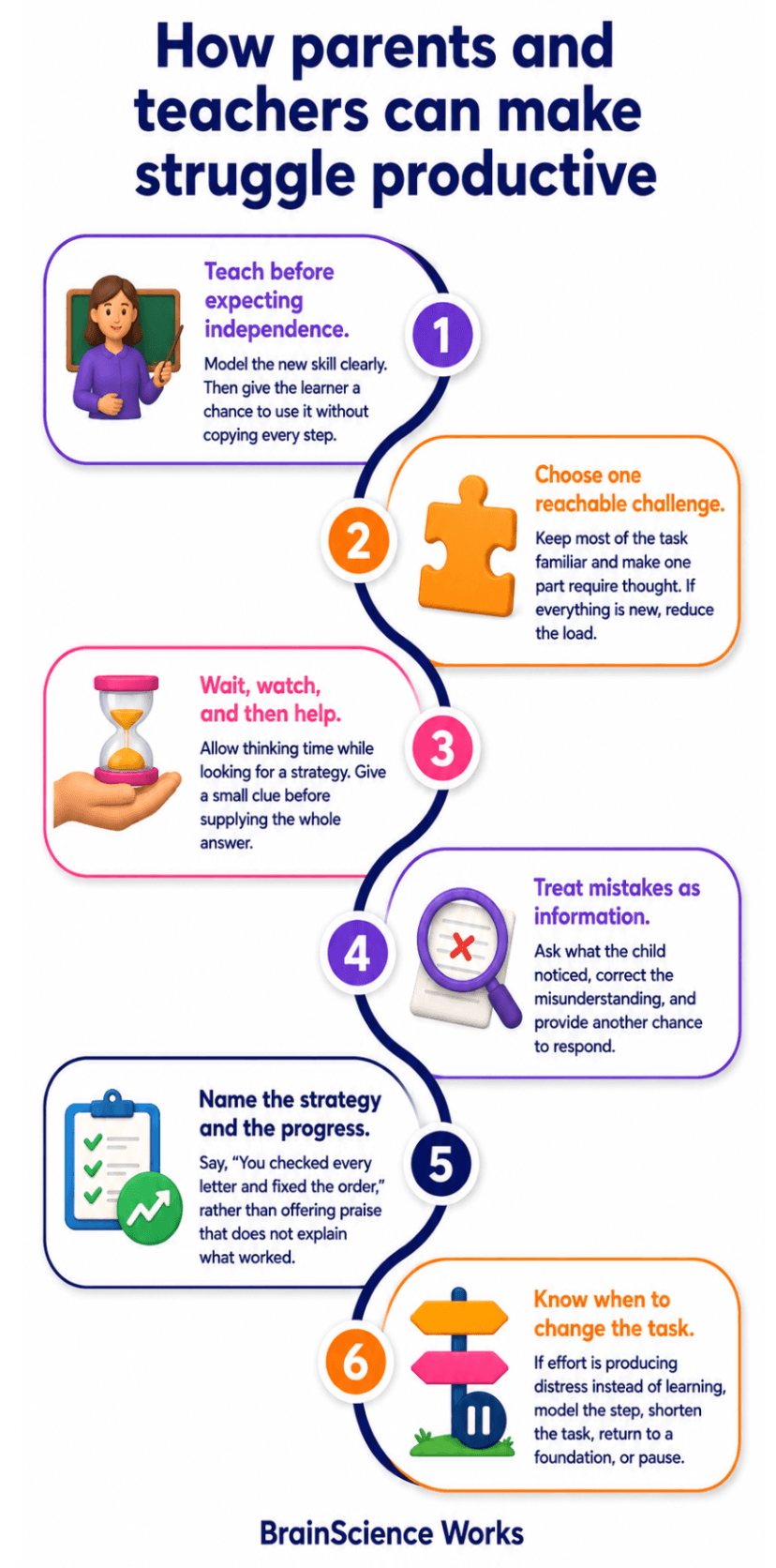
How BrainScience Works turns effort into progress
BrainScience Works lessons use explicit instruction and predictable steps so children know what they are learning and what to do next. Students can work at their own pace instead of being pushed ahead by a fixed group schedule. This creates room for manageable effort while keeping support close.
Clay makes a learner's thinking visible. A child can build a letter or word, look closely at it, compare it with a model, move a part, and correct an error without starting over. When students model what a word means, they can also show understanding that may be stronger than their reading or writing. That strength becomes an entry point for further literacy work.
A child who forgets part of a word can receive a focused cue and rebuild it. A child who knows the idea but cannot yet explain it in print can make a meaning model, talk through the idea, and then reconnect it with the written word. Each successful correction gives the learner concrete evidence of progress. This can support confidence because the success comes from an action the child can understand and use again. [2, 5-8, 11]
A final word
Children do not need every obstacle removed, and they should not be left to fail without a path forward. They need challenges that say, “You have enough to begin, and support is here when you need it.” In that setting, a pause, an error, or a second attempt can become part of learning. Struggle is not proof of failure. When it leads to strategy, feedback, correction, and progress, it can be a visible sign of growth.
Sources
1. Sinha, T., & Kapur, M. (2021). When problem solving followed by instruction works: Evidence for productive failure. Review of Educational Research, 91(5), 761-798.
2. Metcalfe, J. (2017). Learning from errors. Annual Review of Psychology, 68, 465-489.
3. Soderstrom, N. C., & Bjork, R. A. (2015). Learning versus performance: An integrative review. Perspectives on Psychological Science, 10(2), 176-199.
4. Roediger, H. L., III, & Karpicke, J. D. (2006). Test-enhanced learning: Taking memory tests improves long-term retention. Psychological Science, 17(3), 249-255.
5. Shute, V. J. (2008). Focus on formative feedback. Review of Educational Research, 78(1), 153-189.
6. van de Pol, J., Volman, M., & Beishuizen, J. (2010). Scaffolding in teacher-student interaction: A decade of research. Educational Psychology Review, 22, 271-296.
7. National Academies of Sciences, Engineering, and Medicine. (2018). How People Learn II: Learners, Contexts, and Cultures. The National Academies Press.
8. Usher, E. L., & Pajares, F. (2008). Sources of self-efficacy in school: Critical review of the literature and future directions. Review of Educational Research, 78(4), 751-796.
9. Sisk, V. F., Burgoyne, A. P., Sun, J., Butler, J. L., & Macnamara, B. N. (2018). To what extent and under which circumstances are growth mind-sets important to academic achievement? Two meta-analyses. Psychological Science, 29(4), 549-571.
10. Henderlong, J., & Lepper, M. R. (2002). The effects of praise on children's intrinsic motivation: A review and synthesis. Psychological Bulletin, 128(5), 774-795.
11. Foorman, B., Beyler, N., Borradaile, K., Coyne, M., Denton, C. A., Dimino, J., and colleagues. (2016; revised 2019). Foundational Skills to Support Reading for Understanding in Kindergarten Through 3rd Grade. Institute of Education Sciences, U.S. Department of Education.
BrainScience Works Literacy
Build stronger readers, step by step.


About the Author
Shama Hinard
Shama brings 28 years of experience in classroom teaching and school administration to her role at BrainScience Works. Throughout her career, she has been deeply committed to supporting neurodivergent learners and helping each student discover their unique path to success. Over the years, she has led professional development workshops with Learning and the Brain and played a leadership role in the LD school community – organizing retreats, mentoring educators, and advising schools on how to launch effective dyslexia programs.